
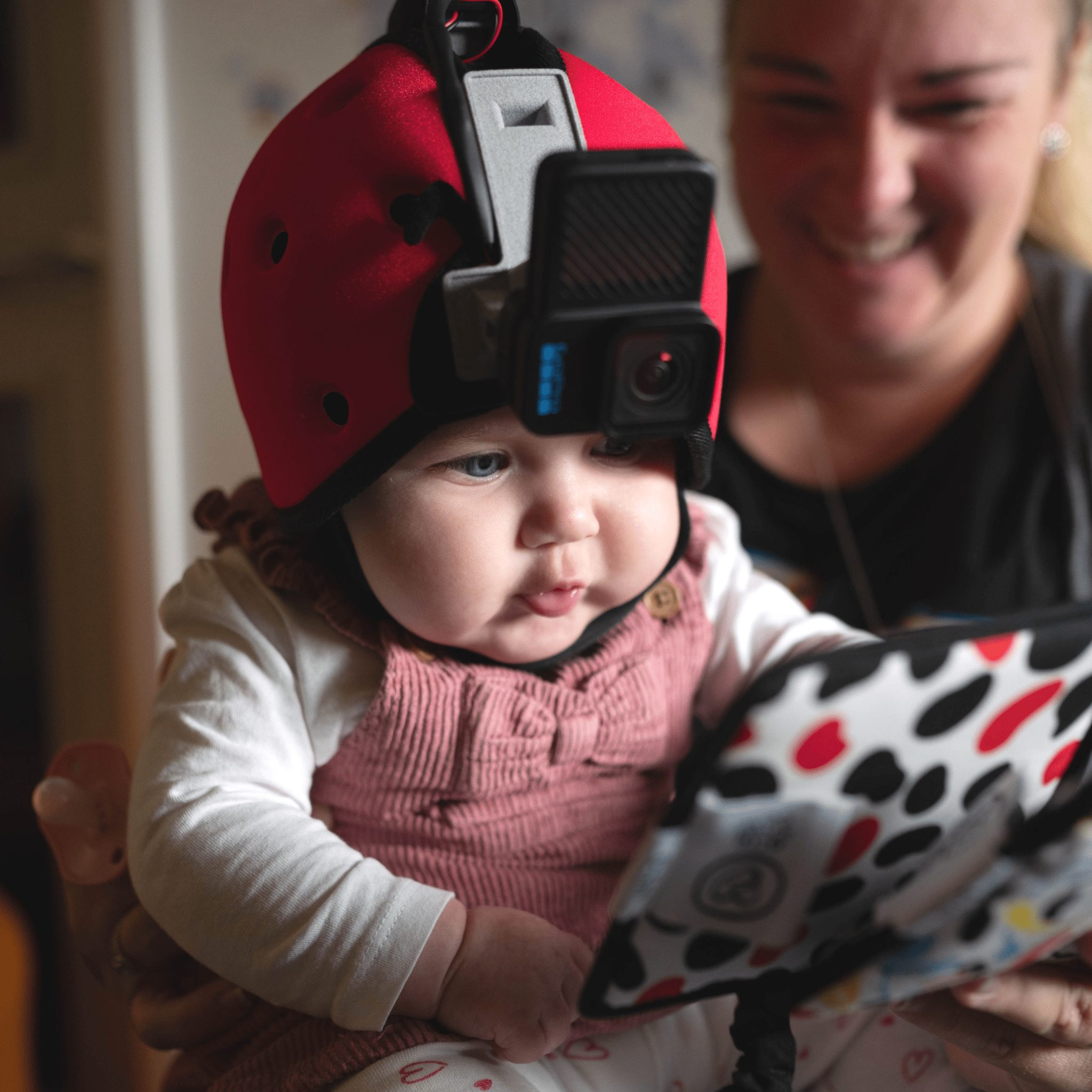
WHY OUR PATTERNS ARE NOT RANDOM
From the moment I had the idea for Etta Loves, I knew science had to be at the heart of it. Not as a nice extra, not as a marketing line, but as the actual starting point for every single thing I designed.
I didn't want to just do monochrome muslins, even though nobody was doing monochrome muslins at the time. I wanted to go further, to step properly into the science of what babies can see, and design from there. That felt important to me then, and ten years on it still drives every single choice we make.
So here is how it actually works, and why it matters.
WE START IN TWO PLACES AT ONCE
Every new Etta Loves pattern begins with two questions asked at the same time.
The first is what are parents going to love? Because becoming a parent can make it very easy to lose your sense of self, and most parents are not looking for cute animals. They want something they would actually choose to have in their home, something that looks considered and beautiful, that sits alongside the rest of their life rather than taking it over.
The second question is what is going to work for their baby's developing vision? What patterns, what complexity, what spacing, what range of scales is going to give that little visual system something genuinely worth focusing on?
The magic of Etta Loves is finding the answer that satisfies both at the same time. A pattern that a stylish parent loves, that also happens to be exactly what their baby needs. That overlap is where we live.

WHAT WE LOOK FOR IN A PATTERN
When our visual experts review a design, they are looking at a few specific things.
Pattern complexity matters, because a baby's brain, just like an adult's, learns best when what it is looking at is not too easy and not too hard. Something too simple stops being interesting very quickly. Something too complex cannot be properly processed yet. The sweet spot is a pattern that always has something new to find.
Spacing matters, because a design needs to be dense enough to hold visual interest, but open enough for a baby's eye to travel across it and appreciate the individual elements within it.
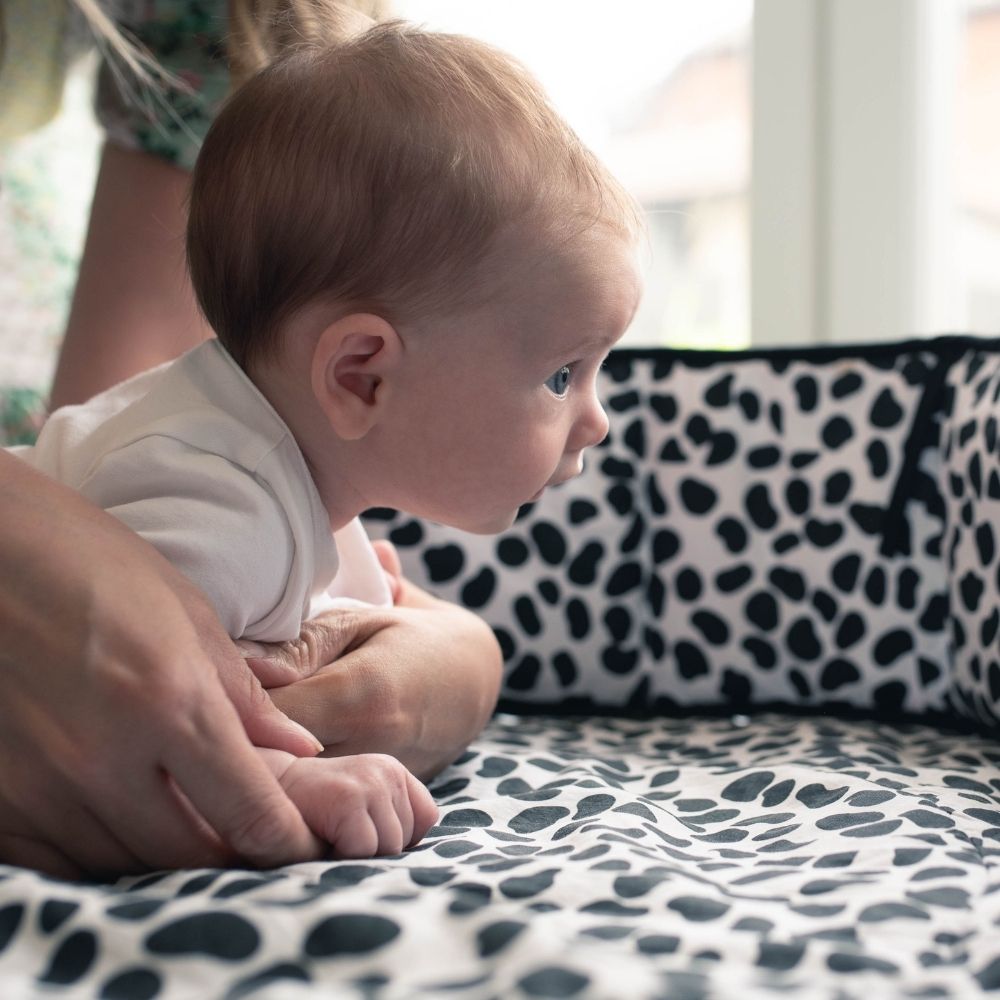
And a range of scales matters enormously. Every Etta Loves pattern contains marks of different sizes, from larger, bolder elements that even the youngest babies can resolve, right down to finer detail that becomes visible as vision sharpens over the coming months. The pattern is never fully solved. There is always something else to discover, which is why parents tell us their baby is still captivated by the same muslin at five months that they loved at five days.

WHY BLACK AND WHITE COMES FIRST
In the first weeks of life, a baby's colour vision is not yet fully operational. Their eyes are working, their brain is active, neural connections are forming at a remarkable rate, but the system that processes colour needs more time to mature.
High contrast black and white gives that developing visual cortex something powerful to work with in the meantime. Babies under five days old consistently prefer patterned surfaces over plain ones. High contrast captures their attention more strongly than anything else at this stage. It is not a trend. It is what the research tells us.
Our 0 to 4 month range is built entirely around this. Not just any black and white patterns, but patterns designed with a range of scales that will remain visually engaging from the first week right through to the moment colour vision properly arrives.
WHY OUR PATTERNS CHANGE AT 5 MONTHS

Around 4 to 5 months, what a baby's visual system can process begins to shift. Colour vision matures, and bold, saturated colours become genuinely easier for the brain to engage with. Pattern recognition, shape processing and visual complexity all develop rapidly around this time.
Think of it like learning to read. You start simple words in large text and work up to smaller text and more complex sentences as your ability grows. A baby's visual system works in a similar way, and our patterns grow with it.
This is why every one of our 5+ month designs always contains a strong, dark anchor, a deep navy or black running through the pattern alongside the colour. When babies hit that 4 / 5 month point, they will naturally orient first towards that high contrast anchor, just as they always have. Then the saturated colours start to draw them in. And gradually, as they approach their first birthday, they begin to notice the subtler shades too.
If you look at our Liberty print, for example, a baby will move first to the dark red, then the green, and eventually, as their vision matures, they will start to detect the difference between the beige and the pale pink. The pattern has layers of discovery built into it at every stage.
THE PROCESS BEHIND EVERY PRINT
We agree on the role a new pattern needs to play and which age range it is designed for. From there, we look at what is beautiful, what feels current or timeless, what we as people with an eye for design would genuinely want in our homes. We work within that world to find something that also provides exactly the right visual stimulation for that stage of development.
From the very beginning, our Consultant Orthoptist Laura is part of the process. We draw on our partnership with the University of Sussex Baby Lab, and design alongside Laura to make sure the scale, pattern complexity and spacing are right for the target age. The proposed designs then go back to Laura and The Baby Lab, where they are tested with real babies in the lab before we refine and finalise if needed. Only when every element is working properly for a baby's developing eyes does a design go to sampling.
Every single pattern in our range has been through this process. Not most of them, all of them.

WHY IT ALL MATTERS
There are a lot of products described as sensory on the market right now. Most of them are black and white because black and white has become a trend, not because the people making them have done the science.
We start from a different place. Etta Loves is built on the belief that babies deserve products designed for them, not just products that look good to parents. The science is not a claim we make or list of sources we reference, it is the process we follow, every single time, for every single thing we make.
When your baby locks onto one of our patterns and will not look away, that is their visual cortex doing exactly what it is designed to do.
We just give them something worth looking at, because looking is learning.
Jen x
Read more about the science here or shop Newborn - 4 months here


Leave a comment
This site is protected by hCaptcha and the hCaptcha Privacy Policy and Terms of Service apply.